I have been reading “Mastering the Art of Command” by Trent Hone this week. Mr. Hone frequently discusses Admiral Chester Nimitz’s philosophy on distributed and unified command, along with the history of how the United States organized the command of military forces in the Pacific Ocean and surrounding areas throughout World War II. I wanted to consolidate some information about the organization and reorganization of Allied command and control in the Pacific during the war and briefly discuss its importance for modern naval officers.
Definitions: Distributed Command & Unified Command
The two ideas of “distributed command” and “unified command” may seem at odds with each other. How can something be both distributed and unified at the same time?
Firstly, the concept of distributed command does not refer to geographic dispersion. Still, it is related to pushing authority down the overall chain of command to more officers who will be able to solve particular problems and focus on the tasks assigned to them. A classic example of distributed command is the US Navy’s Submarine Force. Submarine commanders during World War II were given tasks and then sent on their way to complete these tasks as they saw fit. The same idea was applied to commands such as Admiral William Halsey’s South Pacific Area command, where Halsey could make decisions and seize the initiative against Japan without Nimitz getting directly involved in each decision.
Unified command, on the other hand, describes the consolidation of authority over a given set of military units into one commander. Continuing with the South Pacific Area example, Admiral Halsey had sole authority over every plane, warship, cargo vessel, Sailor, Soldier, and Marine in the geographic area from 100 degrees west to 159 degrees east longitudes and south of the equator. The same unified command structure is still in use today in the form of (you guessed it) unified combatant commands (e.g. Indo-Pacific Command). Both distributed and unified command remain important principles of the US military today.
Figuring Out Pacific Command, 1941-1942
On December 6, 1941, US military forces in the Pacific were organized as follows:
- US Navy Pacific Fleet, Admiral Husband Kimmel
- US Navy Asiatic Fleet, Admiral Thomas Hart
- US Army Hawaiian District, Lieutenant General Walter Short
- US Army Forces Far East (USAFFE), General Douglas MacArthur
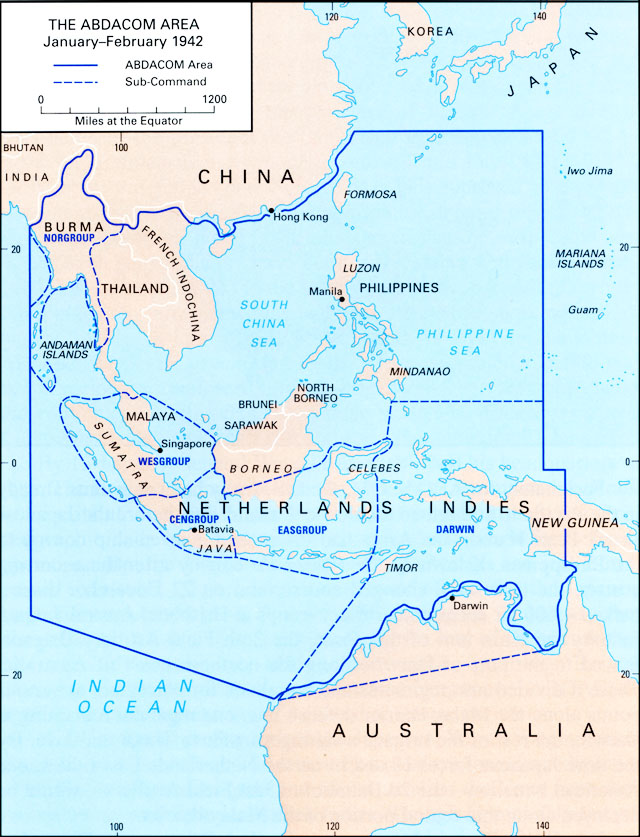
The first change to this structure after Pearl Harbor came on January 1, 1942, when the American-British-Dutch-Australian Command was formed and commanded by General Sir Archibald Wavell of the British Army. ABDA Command would collapse and dissolve into other commands in February 1942. The Anzac Area command existed from 29 January to 18 April 1942 and covered the approaches to Australia and New Zealand as well as the sea lines of communication connecting Australia and Hawaii. The Asiatic Fleet was routed by the Japanese and was dissolved on February 14, 1942.
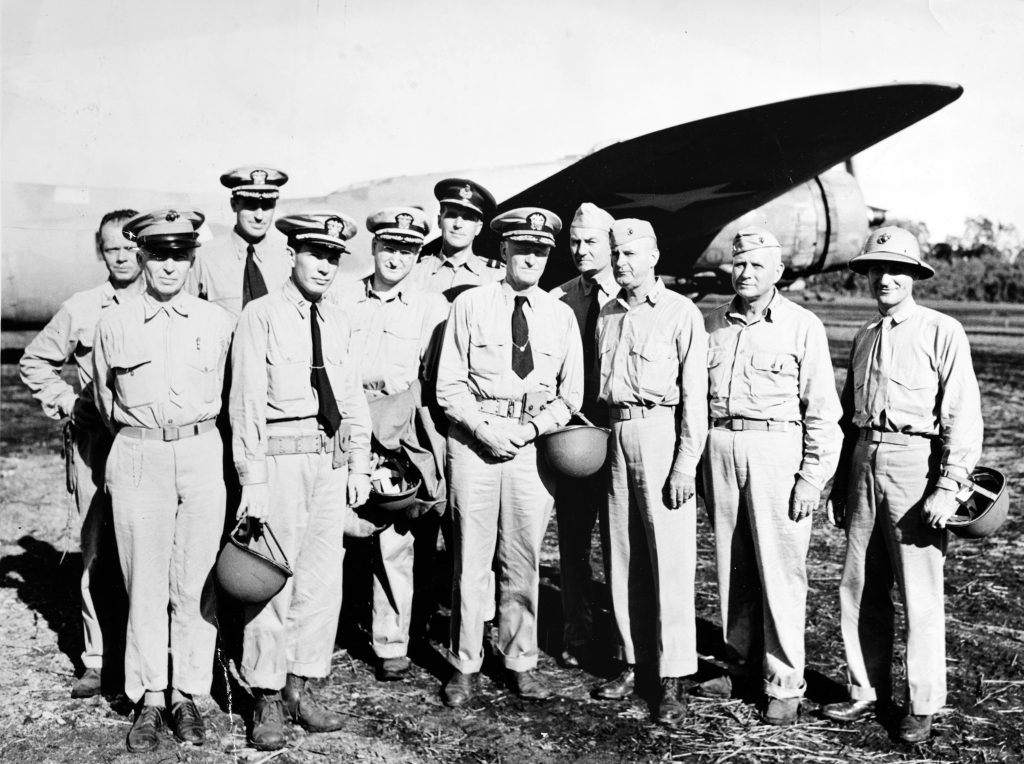
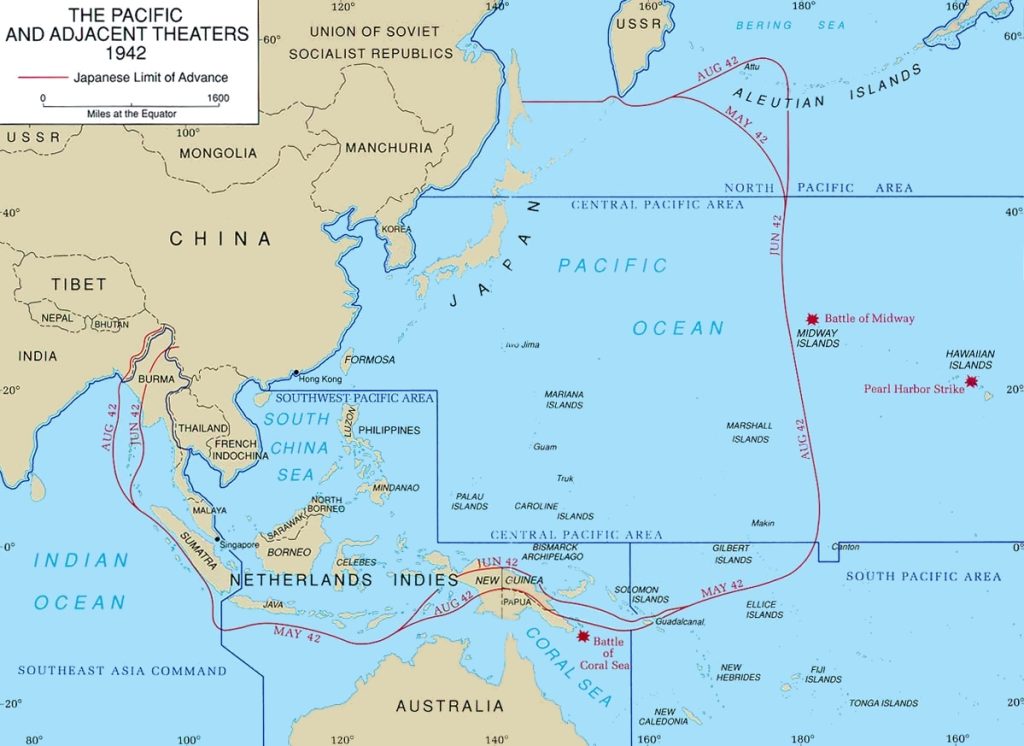
On December 17, 1941, when Admiral Kimmel was relieved of command, Admiral William Pye stepped in as the acting commander. Admiral Pye oversaw the failed defense of Wake Island during his 14-day tenure. Admiral Nimitz arrived in Hawaii and took command on December 31, 1941. By March 1942, the United States military realized a new organization was needed for the Pacific region. On March 30, the Pacific was reorganized into the South West Pacific Area (SWPA) and the Pacific Ocean Areas (POA). The POA command was further subdivided into North, Central, and South Pacific Areas as shown in Figure 3. General MacArthur, having lost most of USAFFE, took command of SWPA, and Admiral Nimitz took command of POA with a dedicated commander for the South Pacific Area, Admiral Robert Ghormley (later Admiral Halsey as noted above). On May 17, 1942, the North Pacific Area got its own dedicated commander, Admiral Robert Theobald. Throughout the war, Nimitz would retain full control of the Central Pacific Area.
Reorganization for Central Pacific Island Hopping, 1943-1945
A year after the South West Pacific Area and Pacific Ocean Areas were formally established, the Navy reorganized the structure of the growing fleet in Nimitz’s area of responsibility. The sum of all naval forces in the central Pacific was organized into a “Big Blue Fleet” with an interesting command structure. The constituent ships that made up this fleet remained the same. Still, the leadership of the fleet alternated between the Third Fleet commanded by Admiral Halsey and the Fifth Fleet commanded by Admiral Raymond Spruance. This swapping of command allowed one admiral and his staff to carry out actions against the Japanese. In contrast, the other admiral and his staff planned the next major operation ashore in Hawaii. The changing fleet names also offered Japanese signals intelligence officers confusion and led to the illusion of two large United States fleets operating in the POA. The Third Fleet was officially established on March 15, 1943, and the Fifth Fleet was officially established on April 26, 1944.
This dual fleet structure in the Central Pacific Area persisted until the end of the war. The North Pacific Area and South Pacific Area commanders continued to exercise unified command over their assigned geographic areas. General MacArthur advanced north from Australia through the Indies and into the Philippines. Some tension existed until the end of the war between MacArthur and the Navy, but the division at the 159 degrees east line was necessary to enable complex operations across the entire Pacific Ocean.
Lessons for Today’s Naval Officers
Naval officers in 2025, preparing for a fight with the People’s Republic of China (PRC) in the same areas of the Pacific Ocean, would be wise to study and learn from the challenges that faced Nimitz during World War II. Sailors may be wise to begin this study with “Mastering the Art of Command” by Trent Hone. Admiral Samuel Paparo, the current commander of United States Indo-Pacific Command (USINDOPACOM), will need to exercise similarly distributed and unified command over joint forces in the Pacific. He will not need to deal with a General MacArthur arguing over strategy, but he will need to coordinate a much more complex web of joint air, surface, undersea, and land forces with their own component commanders. The United States did effectively apply lessons learned during World War II to the organization of the Department of War, but it must remain flexible and open to change in the face of a dynamic PRC threat in the Western Pacific.


Leave a Reply