
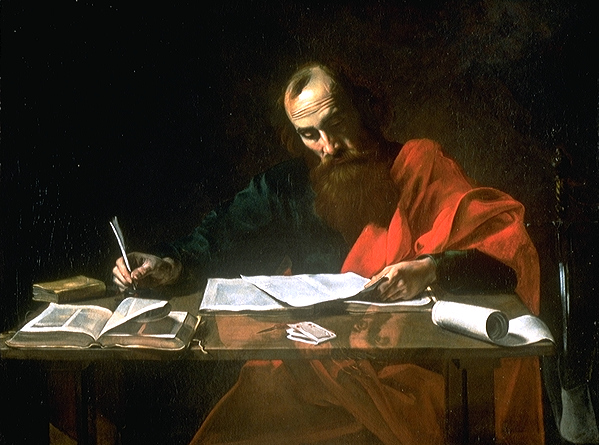
Last Thursday, we began to study Paul’s Epistle to the Romans. We made it through Chapter 1 and Chapter 2 verses 1-16.
The main idea of these passages is that we are all by nature sinful and unable to meet the requirements of God’s just Law.
Paul begins the letter with a traditional greeting saying who the letter is from, who it is to, and adding a salutation at the end. The section on who the letter is from (Romans 1: 1-6) is the longest and is interesting because it lays out his entire mission and life in Christ. He explains that he serves Jesus Christ, is called to be an apostle, and which Gospel he is meant to spread. His calling experience in Acts was a reference we looked at during study:
Now there was a disciple at Damascus named Ananias. The Lord said to him in a vision, “Ananias.” And he said, “Here I am, Lord.” And the Lord said to him, “Rise and go to the street called Straight, and at the house of Judas look for a man of Tarsus named Saul, for behold, he is praying, and he has seen in a vision a man named Ananias come in and lay his hands on him so that he might regain his sight.” But Ananias answered, “Lord, I have heard from many about this man, how much evil he has done to your saints at Jerusalem. And here he has authority from the chief priests to bind all who call on your name.” But the Lord said to him, “Go, for he is a chosen instrument of mine to carry my name before the Gentiles and kings and the children of Israel. For I will show him how much he must suffer for the sake of my name.”
Acts 9: 10-16
Paul also tells the Romans that he is longing to visit the Christian community in Rome, which he has not been able to visit due to his work in the eastern Mediterranean. He points out that he prays for the Christians in Rome every day and that visiting them will be mutually beneficial rather than only a blessing for the Romans.
The next idea from Paul is a short foreshadowing of his main message of the Gospel, which will come later in the letter. Paul writes that he is, “eager to preach the gospel to you… For I am not ashamed of the gospel, for it is the power of God for salvation to everyone who believes…” He ends with this beautiful quote from Habakkuk:
…the righteous shall live by his faith.
Habakkuk 2:4
The following section of the letter, continuing from Chapter 1 to the middle of Chapter 3, serves to convict the reader of their sins and humble them. By pointing out that every person is sinful and incapable of being considered righteous according to their works, Paul paves the way for his later gospel of salvation for those that recognize and repent of their sins.
During our study last week we covered the unrighteousness of the Gentiles and the unrighteousness of the moralists. The Gentiles are described by Paul as lacking the knowledge of God’s written law, but he goes on to point out that they do have God’s law written on their hearts and consciences. Paul provides a vast list of sins that people are guilty of, including homosexual behavior, envy, murder, strife, gossiping, boasting, and more. He condemns atheism. We discussed during study that Psalm 14 opens with a condemnation of atheism:
The fool says in his heart, “There is no God.”
Psalm 14:1
They are corrupt, they do abominable deeds;
there is none who does good.
Paul condemns not just the unrepentant and open sinners, but also those that condemn sin while sinning themselves. These are the hypocrites, both Jew and Gentile. Jesus called out the scribes and Pharisees for their hypocrisy in Matthew 23, and in Proverbs it is written:
Do you see a man who is wise in his own eyes?
Proverbs 26: 12
There is more hope for a fool than for him.
We ended last week’s study with a discussion on God’s judgement of the unrighteous. As we have seen, Paul writes to convince the Romans that no person is righteous according to their own works or thoughts. They are powerless to attain eternal life in God’s kingdom. More than this, God rightly condemns all sinners to death according to his Law.
There will be tribulation and distress for every human being who does evil, the Jew first and also the Greek, but glory and honor and peace for everyone who does good, the Jew first and also the Greek. For God shows no partiality.
Romans 2: 9-11
This may seem to leave open a way to the peace of heaven that is through doing good. The problem is that Paul has already made clear and will continue to emphasize that no person is good, or even capable of doing good, on their own. Everyone faces the tribulation and distress of God’s judgement, and, if they are honest with themselves, recognize that they need some help.
This is essential to understand before the beautiful good news of Christ’s death and resurrection can be fully understood and appreciated. How could a person be overwhelmed by the grace that Jesus has shown to them in laying down his life to pay for their sins if they do not know how sinful they really are? Paul will take us there in the coming weeks. I look forward to studying with the men at my church and growing in faith together.
O almighty God, merciful Father, I, a poor, miserable sinner, confess unto You all my sins and iniquities with which I have ever offended You and justly deserved Your temporal and eternal punishment. But I am heartily sorry for them and sincerely repent of them, and I pray You of Your boundless mercy and for the sake of the holy, innocent, bitter sufferings and death of Your beloved Son, Jesus Christ, to be gracious and merciful to me, a poor, sinful being.
Lutheran Service Book, pg. 291

Leave a Reply